> ## Documentation Index
> Fetch the complete documentation index at: https://langchain-5e9cc07a-preview-orgrol-1766173255-e2d754f.mintlify.site/llms.txt
> Use this file to discover all available pages before exploring further.
# Trace Claude Code
This guide shows you how to automatically send conversations from the [Claude Code CLI](https://code.claude.com/docs/en/overview) to LangSmith.
Once configured, you can opt-in to sending traces from Claude Code projects to LangSmith. Traces will include user messages, tool calls and assistant responses.
## How it works
1. A global "Stop" [hook](https://code.claude.com/docs/en/hooks-guide#get-started-with-claude-code-hooks) is configured to run each time Claude Code responds.
2. The hook reads Claude Code’s generated conversation transcripts.
3. Messages in the transcript are converted into LangSmith runs and sent to your LangSmith project.
Tracing is opt-in and is enabled per Claude Code project using environment variables.
## Prerequisites
Before setting up tracing, ensure you have:
* **Claude Code CLI** installed.
* **LangSmith API key** ([get it here](https://smith.langchain.com/settings/apikeys)).
* **Command-line tool** `jq` - JSON processor ([install guide](https://jqlang.github.io/jq/download/))
This guide currently only supports macOS.
## 1. Create the hook script
`stop_hook.sh` processes Claude Code's generated conversation transcripts and sends traces to LangSmith. Create the file `~/.claude/hooks/stop_hook.sh` with the following script:
```bash theme={null}
#!/bin/bash
###
# Claude Code Stop Hook - LangSmith Tracing Integration
# Sends Claude Code traces to LangSmith after each response.
###
set -e
# Config (needed early for logging)
LOG_FILE="$HOME/.claude/state/hook.log"
DEBUG="$(echo "$CC_LANGSMITH_DEBUG" | tr '[:upper:]' '[:lower:]')"
# Logging functions
log() {
local level="$1"
shift
echo "$(date '+%Y-%m-%d %H:%M:%S') [$level] $*" >> "$LOG_FILE"
}
debug() {
if [ "$DEBUG" = "true" ]; then
log "DEBUG" "$@"
fi
}
# Immediate debug logging
debug "Hook started, TRACE_TO_LANGSMITH=$TRACE_TO_LANGSMITH"
# Exit early if tracing disabled
if [ "$(echo "$TRACE_TO_LANGSMITH" | tr '[:upper:]' '[:lower:]')" != "true" ]; then
debug "Tracing disabled, exiting early"
exit 0
fi
# Required commands
for cmd in jq curl uuidgen; do
if ! command -v "$cmd" &> /dev/null; then
echo "Error: $cmd is required but not installed" >&2
exit 0
fi
done
# Config (continued)
API_KEY="${CC_LANGSMITH_API_KEY:-$LANGSMITH_API_KEY}"
PROJECT="${CC_LANGSMITH_PROJECT:-claude-code}"
API_BASE="https://api.smith.langchain.com"
STATE_FILE="$HOME/.claude/state/langsmith_state.json"
# Global variables
CURRENT_TURN_ID="" # Track current turn run for cleanup on exit
# Ensure state directory exists
mkdir -p "$(dirname "$STATE_FILE")"
# Validate API key
if [ -z "$API_KEY" ]; then
log "ERROR" "CC_LANGSMITH_API_KEY not set"
exit 0
fi
# Get microseconds portably (macOS doesn't support date +%N)
get_microseconds() {
if command -v gdate &> /dev/null; then
# Use GNU date if available (brew install coreutils)
gdate +%6N
elif [[ "$OSTYPE" == "darwin"* ]]; then
# macOS fallback: use Python for microseconds
python3 -c "import time; print(str(int(time.time() * 1000000) % 1000000).zfill(6))"
else
# Linux/GNU date
date +%6N
fi
}
# Get file size portably (macOS and Linux have different stat syntax)
get_file_size() {
local file="$1"
if [[ "$OSTYPE" == "darwin"* ]]; then
stat -f%z "$file"
else
stat -c%s "$file"
fi
}
# API call helper
api_call() {
local method="$1"
local endpoint="$2"
local data="$3"
local response
local http_code
response=$(curl -s --max-time 60 -w "\n%{http_code}" -X "$method" \
-H "x-api-key: $API_KEY" \
-H "Content-Type: application/json" \
-d "$data" \
"$API_BASE$endpoint" 2>&1)
http_code=$(echo "$response" | tail -n1)
response=$(echo "$response" | sed '$d')
if [ "$http_code" -lt 200 ] || [ "$http_code" -ge 300 ]; then
log "ERROR" "API call failed: $method $endpoint"
log "ERROR" "HTTP $http_code: $response"
log "ERROR" "Request data: ${data:0:500}"
return 1
fi
echo "$response"
}
# Cleanup function to complete pending turn run on exit
cleanup_pending_turn() {
if [ -n "$CURRENT_TURN_ID" ]; then
debug "Cleanup: completing pending turn run $CURRENT_TURN_ID"
local now
now=$(date -u +"%Y-%m-%dT%H:%M:%SZ")
local turn_update
turn_update=$(jq -n \
--arg time "$now" \
'{
outputs: {messages: []},
end_time: $time,
error: "Incomplete: script exited early"
}')
# Try to complete the turn run (ignore errors since we're exiting anyway)
api_call "PATCH" "/runs/$CURRENT_TURN_ID" "$turn_update" > /dev/null 2>&1 || true
log "WARN" "Completed pending turn run $CURRENT_TURN_ID due to early exit"
fi
}
# Set trap to cleanup on exit (EXIT covers normal exit, errors, and interrupts)
trap cleanup_pending_turn EXIT
# Load state
load_state() {
if [ ! -f "$STATE_FILE" ]; then
echo "{}"
return
fi
cat "$STATE_FILE"
}
# Save state
save_state() {
local state="$1"
echo "$state" > "$STATE_FILE"
}
# Get message content
get_content() {
local msg="$1"
echo "$msg" | jq -c 'if type == "object" and has("message") then .message.content elif type == "object" then .content else null end'
}
# Check if message is tool result
is_tool_result() {
local msg="$1"
local content
content=$(get_content "$msg")
echo "$content" | jq -e 'if type == "array" then any(.[]; type == "object" and .type == "tool_result") else false end' > /dev/null 2>&1
}
# Format content blocks for LangSmith
format_content() {
local msg="$1"
local content
content=$(get_content "$msg")
# Handle string content
if echo "$content" | jq -e 'type == "string"' > /dev/null 2>&1; then
echo "$content" | jq '[{"type": "text", "text": .}]'
return
fi
# Handle array content
if echo "$content" | jq -e 'type == "array"' > /dev/null 2>&1; then
echo "$content" | jq '[
.[] |
if type == "object" then
if .type == "text" then
{"type": "text", "text": .text}
elif .type == "thinking" then
{"type": "thinking", "thinking": .thinking}
elif .type == "tool_use" then
{"type": "tool_call", "name": .name, "args": .input, "id": .id}
else
.
end
elif type == "string" then
{"type": "text", "text": .}
else
.
end
] | if length == 0 then [{"type": "text", "text": ""}] else . end'
return
fi
# Default
echo '[{"type": "text", "text": ""}]'
}
# Get tool uses from message
get_tool_uses() {
local msg="$1"
local content
content=$(get_content "$msg")
# Check if content is an array
if ! echo "$content" | jq -e 'type == "array"' > /dev/null 2>&1; then
echo "[]"
return
fi
echo "$content" | jq -c '[.[] | select(type == "object" and .type == "tool_use")]'
}
# Find tool result
find_tool_result() {
local tool_id="$1"
local tool_results="$2"
local result
result=$(echo "$tool_results" | jq -r --arg id "$tool_id" '
first(
.[] |
(if type == "object" and has("message") then .message.content elif type == "object" then .content else null end) as $content |
if $content | type == "array" then
$content[] |
select(type == "object" and .type == "tool_result" and .tool_use_id == $id) |
if .content | type == "array" then
[.content[] | select(type == "object" and .type == "text") | .text] | join(" ")
elif .content | type == "string" then
.content
else
.content | tostring
end
else
empty
end
) // ""
')
if [ -z "$result" ]; then
echo "No result"
else
echo "$result"
fi
}
# Merge assistant message parts
merge_assistant_parts() {
local current_assistant_parts="$1"
echo "$current_assistant_parts" | jq -s '
.[0][0] as $base |
(.[0] | map(if type == "object" and has("message") then .message.content elif type == "object" then .content else null end) | map(select(. != null))) as $contents |
($contents | map(
if type == "string" then [{"type":"text","text":.}]
elif type == "array" then .
else [.]
end
) | add // []) as $merged_content |
($merged_content | reduce .[] as $item (
{result: [], buffer: null};
if $item.type == "text" then
if .buffer then .buffer.text += $item.text
else .buffer = $item
end
else
(if .buffer then .result += [.buffer] else . end) |
.buffer = null | .result += [$item]
end
) | if .buffer then .result + [.buffer] else .result end) as $final_content |
$base | if type == "object" and has("message") then .message.content = $final_content elif type == "object" then .content = $final_content else . end
'
}
# Serialize run data for multipart upload
# Writes parts to temp files and outputs curl -F arguments (one per line)
serialize_for_multipart() {
local operation="$1" # "post" or "patch"
local run_json="$2" # Full run JSON
local temp_dir="$3" # Temp directory for this batch
local run_id
run_id=$(echo "$run_json" | jq -r '.id')
# Extract inputs/outputs from main data
local inputs
inputs=$(echo "$run_json" | jq -c '.inputs // empty')
local outputs
outputs=$(echo "$run_json" | jq -c '.outputs // empty')
local main_data
main_data=$(echo "$run_json" | jq -c 'del(.inputs, .outputs)')
# Part 1: Main run data with Content-Length header
local main_file="$temp_dir/${operation}_${run_id}_main.json"
echo "$main_data" > "$main_file"
local main_size=$(get_file_size "$main_file")
echo "-F"
echo "${operation}.${run_id}=<${main_file};type=application/json;headers=Content-Length:${main_size}"
# Part 2: Inputs (if present) with Content-Length header
if [ "$inputs" != "null" ] && [ -n "$inputs" ]; then
local inputs_file="$temp_dir/${operation}_${run_id}_inputs.json"
echo "$inputs" > "$inputs_file"
local inputs_size=$(get_file_size "$inputs_file")
echo "-F"
echo "${operation}.${run_id}.inputs=<${inputs_file};type=application/json;headers=Content-Length:${inputs_size}"
fi
# Part 3: Outputs (if present) with Content-Length header
if [ "$outputs" != "null" ] && [ -n "$outputs" ]; then
local outputs_file="$temp_dir/${operation}_${run_id}_outputs.json"
echo "$outputs" > "$outputs_file"
local outputs_size=$(get_file_size "$outputs_file")
echo "-F"
echo "${operation}.${run_id}.outputs=<${outputs_file};type=application/json;headers=Content-Length:${outputs_size}"
fi
}
# Send batch of runs via multipart endpoint
send_multipart_batch() {
local operation="$1" # "post" or "patch"
local batch_json="$2" # JSON array of runs
# Parse batch size
local batch_size
batch_size=$(echo "$batch_json" | jq 'length')
if [ "$batch_size" -eq 0 ]; then
debug "No $operation runs to send"
return 0
fi
# Create temp directory for this batch
local temp_dir
temp_dir=$(mktemp -d)
# Build multipart curl command
local curl_args=()
curl_args+=("-s" "--max-time" "60" "-w" "\n%{http_code}" "-X" "POST")
curl_args+=("-H" "x-api-key: $API_KEY")
# Serialize each run and collect curl -F arguments
while IFS= read -r run; do
# Read arguments line by line (proper array handling, no word splitting)
while IFS= read -r arg; do
curl_args+=("$arg")
done < <(serialize_for_multipart "$operation" "$run" "$temp_dir")
done < <(echo "$batch_json" | jq -c '.[]')
curl_args+=("$API_BASE/runs/multipart")
# Execute curl
local response
local http_code
response=$(curl "${curl_args[@]}" 2>&1)
http_code=$(echo "$response" | tail -n1)
response=$(echo "$response" | sed '$d')
# Cleanup temp directory
rm -rf "$temp_dir"
if [ "$http_code" -lt 200 ] || [ "$http_code" -ge 300 ]; then
log "ERROR" "Batch $operation failed: HTTP $http_code"
log "ERROR" "Response: $response"
return 1
fi
log "INFO" "Batch $operation succeeded: $batch_size runs"
return 0
}
# Create LangSmith trace
create_trace() {
local session_id="$1"
local turn_num="$2"
local user_msg="$3"
local assistant_messages="$4" # JSON array of assistant messages
local tool_results="$5"
# Initialize batch collectors for this trace
local posts_batch="[]"
local patches_batch="[]"
local turn_id
turn_id=$(uuidgen | tr '[:upper:]' '[:lower:]')
local user_content
user_content=$(format_content "$user_msg")
local now
now=$(date -u +"%Y-%m-%dT%H:%M:%SZ")
# Create dotted_order timestamp with microseconds (format: YYYYMMDDTHHMMSSffffffZ)
local dotted_timestamp
dotted_timestamp=$(date -u +"%Y%m%dT%H%M%S")
local microseconds
microseconds=$(get_microseconds)
dotted_timestamp="${dotted_timestamp}${microseconds}Z"
# Create top-level turn run with dotted_order and trace_id
# For top-level run: trace_id = run_id
local turn_dotted_order="${dotted_timestamp}${turn_id}"
local turn_data
turn_data=$(jq -n \
--arg id "$turn_id" \
--arg trace_id "$turn_id" \
--arg name "Claude Code" \
--arg project "$PROJECT" \
--arg session "$session_id" \
--arg time "$now" \
--argjson content "$user_content" \
--arg turn "$turn_num" \
--arg dotted_order "$turn_dotted_order" \
'{
id: $id,
trace_id: $trace_id,
name: $name,
run_type: "chain",
inputs: {messages: [{role: "user", content: $content}]},
start_time: $time,
dotted_order: $dotted_order,
session_name: $project,
extra: {metadata: {thread_id: $session}},
tags: ["claude-code", ("turn-" + $turn)]
}')
posts_batch=$(echo "$posts_batch" | jq --argjson data "$turn_data" '. += [$data]')
# Track this turn for cleanup on early exit
CURRENT_TURN_ID="$turn_id"
# Build final outputs array (accumulates all LLM responses)
local all_outputs
all_outputs=$(jq -n --argjson content "$user_content" '[{role: "user", content: $content}]')
# Process each assistant message (each represents one LLM call)
local llm_num=0
local last_llm_end="$now"
while IFS= read -r assistant_msg; do
llm_num=$((llm_num + 1))
# Extract timestamp from message for proper ordering
local msg_timestamp
msg_timestamp=$(echo "$assistant_msg" | jq -r '.timestamp // ""')
# Use message timestamp for LLM start time
local llm_start
if [ -n "$msg_timestamp" ]; then
llm_start="$msg_timestamp"
elif [ $llm_num -eq 1 ]; then
llm_start="$now"
else
llm_start="$last_llm_end"
fi
# Create assistant run
local assistant_id
assistant_id=$(uuidgen | tr '[:upper:]' '[:lower:]')
local tool_uses
tool_uses=$(get_tool_uses "$assistant_msg")
local assistant_content
assistant_content=$(format_content "$assistant_msg")
# Build inputs for this LLM call (includes accumulated context)
local llm_inputs
llm_inputs=$(jq -n --argjson outputs "$all_outputs" '{messages: $outputs}')
# Create dotted_order for assistant (child of turn)
# Convert ISO timestamp to dotted_order format
# From: 2025-12-16T17:44:04.397Z
# To: 20251216T174404397000Z (milliseconds padded to microseconds)
local assistant_timestamp
if [ -n "$msg_timestamp" ]; then
# Extract and convert timestamp from message
assistant_timestamp=$(echo "$msg_timestamp" | sed 's/[-:]//g; s/\.\([0-9]*\)Z$/\1000Z/; s/T\([0-9]*\)\([0-9]\{3\}\)000Z$/T\1\2000Z/')
else
# Fallback to current time if no timestamp
assistant_timestamp=$(date -u +"%Y%m%dT%H%M%S")
local assistant_microseconds
assistant_microseconds=$(get_microseconds)
assistant_timestamp="${assistant_timestamp}${assistant_microseconds}Z"
fi
local assistant_dotted_order="${turn_dotted_order}.${assistant_timestamp}${assistant_id}"
# Extract trace_id from parent dotted_order (UUID after the Z)
# Format: 20231215T120000123456Zuuid -> uuid
local trace_id
trace_id="${turn_dotted_order#*Z}"
local assistant_data
assistant_data=$(jq -n \
--arg id "$assistant_id" \
--arg trace_id "$trace_id" \
--arg parent "$turn_id" \
--arg name "Claude" \
--arg project "$PROJECT" \
--arg time "$llm_start" \
--argjson inputs "$llm_inputs" \
--arg dotted_order "$assistant_dotted_order" \
'{
id: $id,
trace_id: $trace_id,
parent_run_id: $parent,
name: $name,
run_type: "llm",
inputs: $inputs,
start_time: $time,
dotted_order: $dotted_order,
session_name: $project,
extra: {metadata: {ls_provider: "anthropic", ls_model_name: "claude-sonnet-4-5"}},
tags: ["claude-sonnet-4-5"]
}')
posts_batch=$(echo "$posts_batch" | jq --argjson data "$assistant_data" '. += [$data]')
# Build outputs for this LLM call
local llm_outputs
llm_outputs=$(jq -n --argjson content "$assistant_content" '[{role: "assistant", content: $content}]')
# Track when this LLM iteration ends (after tools complete)
local assistant_end
# Create tool runs as siblings of the assistant run
if [ "$(echo "$tool_uses" | jq 'length')" -gt 0 ]; then
# Tools start immediately after LLM outputs (slight delay for realism)
local tool_start
tool_start=$(date -u +"%Y-%m-%dT%H:%M:%SZ")
while IFS= read -r tool; do
local tool_id
tool_id=$(uuidgen | tr '[:upper:]' '[:lower:]')
local tool_name
tool_name=$(echo "$tool" | jq -r '.name // "tool"')
local tool_input
tool_input=$(echo "$tool" | jq '.input // {}')
local tool_use_id
tool_use_id=$(echo "$tool" | jq -r '.id // ""')
# Create dotted_order for tool (child of turn)
local tool_timestamp
tool_timestamp=$(date -u +"%Y%m%dT%H%M%S")
local tool_microseconds
tool_microseconds=$(get_microseconds)
tool_timestamp="${tool_timestamp}${tool_microseconds}Z"
local tool_dotted_order="${turn_dotted_order}.${tool_timestamp}${tool_id}"
# Tools are siblings of the assistant run (both children of turn run)
local tool_data
tool_data=$(jq -n \
--arg id "$tool_id" \
--arg trace_id "$trace_id" \
--arg parent "$turn_id" \
--arg name "$tool_name" \
--arg project "$PROJECT" \
--arg time "$tool_start" \
--argjson input "$tool_input" \
--arg dotted_order "$tool_dotted_order" \
'{
id: $id,
trace_id: $trace_id,
parent_run_id: $parent,
name: $name,
run_type: "tool",
inputs: {input: $input},
start_time: $time,
dotted_order: $dotted_order,
session_name: $project,
tags: ["tool"]
}')
posts_batch=$(echo "$posts_batch" | jq --argjson data "$tool_data" '. += [$data]')
# Find and add tool result
local result
result=$(find_tool_result "$tool_use_id" "$tool_results")
local tool_end
tool_end=$(date -u +"%Y-%m-%dT%H:%M:%SZ")
local tool_update
tool_update=$(echo "$result" | jq -Rs \
--arg time "$tool_end" \
--arg id "$tool_id" \
--arg trace_id "$trace_id" \
--arg parent "$turn_id" \
--arg dotted_order "$tool_dotted_order" \
'{
id: $id,
trace_id: $trace_id,
parent_run_id: $parent,
dotted_order: $dotted_order,
outputs: {output: .},
end_time: $time
}')
patches_batch=$(echo "$patches_batch" | jq --argjson data "$tool_update" '. += [$data]')
# Next tool starts after this one ends
tool_start="$tool_end"
done < <(echo "$tool_uses" | jq -c '.[]')
# Assistant completes after all tools finish
assistant_end="$tool_start"
else
# No tools, assistant completes immediately
assistant_end=$(date -u +"%Y-%m-%dT%H:%M:%SZ")
fi
# Now complete the assistant run
local assistant_update
assistant_update=$(jq -n \
--arg time "$assistant_end" \
--arg id "$assistant_id" \
--arg trace_id "$trace_id" \
--arg parent "$turn_id" \
--arg dotted_order "$assistant_dotted_order" \
--argjson outputs "$llm_outputs" \
'{
id: $id,
trace_id: $trace_id,
parent_run_id: $parent,
dotted_order: $dotted_order,
outputs: {messages: $outputs},
end_time: $time
}')
patches_batch=$(echo "$patches_batch" | jq --argjson data "$assistant_update" '. += [$data]')
# Save end time for next LLM start
last_llm_end="$assistant_end"
# Add to overall outputs
all_outputs=$(echo "$all_outputs" | jq --argjson new "$llm_outputs" '. += $new')
# Add tool results to accumulated context (for next LLM's inputs)
if [ "$(echo "$tool_uses" | jq 'length')" -gt 0 ]; then
while IFS= read -r tool; do
local tool_use_id
tool_use_id=$(echo "$tool" | jq -r '.id // ""')
local result
result=$(find_tool_result "$tool_use_id" "$tool_results")
all_outputs=$(echo "$all_outputs" | jq \
--arg id "$tool_use_id" \
--arg result "$result" \
'. += [{role: "tool", tool_call_id: $id, content: [{type: "text", text: $result}]}]')
done < <(echo "$tool_uses" | jq -c '.[]')
fi
done < <(echo "$assistant_messages" | jq -c '.[]')
# Update turn run with all outputs
# Filter out user messages from final outputs
local turn_outputs
turn_outputs=$(echo "$all_outputs" | jq '[.[] | select(.role != "user")]')
# Use the last LLM's end time as the turn end time
local turn_end="$last_llm_end"
local turn_update
turn_update=$(jq -n \
--arg time "$turn_end" \
--arg id "$turn_id" \
--arg trace_id "$turn_id" \
--arg dotted_order "$turn_dotted_order" \
--argjson outputs "$turn_outputs" \
'{
id: $id,
trace_id: $trace_id,
dotted_order: $dotted_order,
outputs: {messages: $outputs},
end_time: $time
}')
patches_batch=$(echo "$patches_batch" | jq --argjson data "$turn_update" '. += [$data]')
# Send both batches
send_multipart_batch "post" "$posts_batch" || true
send_multipart_batch "patch" "$patches_batch" || true
# Clear the tracked turn since it's now complete
CURRENT_TURN_ID=""
log "INFO" "Created turn $turn_num: $turn_id with $llm_num LLM call(s)"
}
# Main function
main() {
# Track execution time
local script_start
script_start=$(date +%s)
# Read hook input
local hook_input
hook_input=$(cat)
# Check stop_hook_active flag
if echo "$hook_input" | jq -e '.stop_hook_active == true' > /dev/null 2>&1; then
debug "stop_hook_active=true, skipping"
exit 0
fi
# Extract session info
local session_id
session_id=$(echo "$hook_input" | jq -r '.session_id // ""')
local transcript_path
transcript_path=$(echo "$hook_input" | jq -r '.transcript_path // ""' | sed "s|^~|$HOME|")
if [ -z "$session_id" ] || [ ! -f "$transcript_path" ]; then
log "WARN" "Invalid input: session=$session_id, transcript=$transcript_path"
exit 0
fi
log "INFO" "Processing session $session_id"
# Load state
local state
state=$(load_state)
local last_line
last_line=$(echo "$state" | jq -r --arg sid "$session_id" '.[$sid].last_line // -1')
local turn_count
turn_count=$(echo "$state" | jq -r --arg sid "$session_id" '.[$sid].turn_count // 0')
# Parse new messages
local new_messages
new_messages=$(awk -v start="$last_line" 'NR > start + 1 && NF' "$transcript_path")
if [ -z "$new_messages" ]; then
debug "No new messages"
exit 0
fi
local msg_count
msg_count=$(echo "$new_messages" | wc -l)
log "INFO" "Found $msg_count new messages"
# Group into turns
local current_user=""
local current_assistants="[]" # Array of assistant messages
local current_msg_id="" # Current assistant message ID
local current_assistant_parts="[]" # Parts of current assistant message
local current_tool_results="[]"
local turns=0
local new_last_line=$last_line
while IFS= read -r line; do
new_last_line=$((new_last_line + 1))
if [ -z "$line" ]; then
continue
fi
local role
role=$(echo "$line" | jq -r 'if type == "object" and has("message") then .message.role elif type == "object" then .role else "unknown" end')
if [ "$role" = "user" ]; then
if is_tool_result "$line"; then
# Add to tool results
current_tool_results=$(echo "$current_tool_results" | jq --argjson msg "$line" '. += [$msg]')
else
# New turn - finalize any pending assistant message
if [ -n "$current_msg_id" ] && [ "$(echo "$current_assistant_parts" | jq 'length')" -gt 0 ]; then
# Merge parts and add to assistants array
local merged
merged=$(merge_assistant_parts "$current_assistant_parts")
current_assistants=$(echo "$current_assistants" | jq --argjson msg "$merged" '. += [$msg]')
current_assistant_parts="[]"
current_msg_id=""
fi
# Create trace for previous turn
if [ -n "$current_user" ] && [ "$(echo "$current_assistants" | jq 'length')" -gt 0 ]; then
turns=$((turns + 1))
local turn_num=$((turn_count + turns))
create_trace "$session_id" "$turn_num" "$current_user" "$current_assistants" "$current_tool_results" || true
fi
# Start new turn
current_user="$line"
current_assistants="[]"
current_assistant_parts="[]"
current_msg_id=""
current_tool_results="[]"
fi
elif [ "$role" = "assistant" ]; then
# Get message ID
local msg_id
msg_id=$(echo "$line" | jq -r 'if type == "object" and has("message") then .message.id else "" end')
if [ -z "$msg_id" ]; then
# No message ID, treat as continuation of current message
current_assistant_parts=$(echo "$current_assistant_parts" | jq --argjson msg "$line" '. += [$msg]')
elif [ "$msg_id" = "$current_msg_id" ]; then
# Same message ID, add to current parts
current_assistant_parts=$(echo "$current_assistant_parts" | jq --argjson msg "$line" '. += [$msg]')
else
# New message ID - finalize previous message if any
if [ -n "$current_msg_id" ] && [ "$(echo "$current_assistant_parts" | jq 'length')" -gt 0 ]; then
# Merge parts and add to assistants array
local merged
merged=$(merge_assistant_parts "$current_assistant_parts")
current_assistants=$(echo "$current_assistants" | jq --argjson msg "$merged" '. += [$msg]')
fi
# Start new assistant message
current_msg_id="$msg_id"
current_assistant_parts=$(jq -n --argjson msg "$line" '[$msg]')
fi
fi
done <<< "$new_messages"
# Process final turn - finalize any pending assistant message
if [ -n "$current_msg_id" ] && [ "$(echo "$current_assistant_parts" | jq 'length')" -gt 0 ]; then
local merged
merged=$(merge_assistant_parts "$current_assistant_parts")
current_assistants=$(echo "$current_assistants" | jq --argjson msg "$merged" '. += [$msg]')
fi
if [ -n "$current_user" ] && [ "$(echo "$current_assistants" | jq 'length')" -gt 0 ]; then
turns=$((turns + 1))
local turn_num=$((turn_count + turns))
create_trace "$session_id" "$turn_num" "$current_user" "$current_assistants" "$current_tool_results" || true
fi
# Update state
local updated
updated=$(date -u +"%Y-%m-%dT%H:%M:%SZ")
state=$(echo "$state" | jq \
--arg sid "$session_id" \
--arg line "$new_last_line" \
--arg count "$((turn_count + turns))" \
--arg time "$updated" \
'.[$sid] = {last_line: ($line | tonumber), turn_count: ($count | tonumber), updated: $time}')
save_state "$state"
# Log execution time
local script_end
script_end=$(date +%s)
local duration=$((script_end - script_start))
log "INFO" "Processed $turns turns in ${duration}s"
if [ "$duration" -gt 180 ]; then
log "WARN" "Hook took ${duration}s (>3min), consider optimizing"
fi
}
# Run main
main
exit 0
```
Make it executable:
```bash theme={null}
chmod +x ~/.claude/hooks/stop_hook.sh
```
## 2. Configure the global hook
Set up a global hook in `~/.claude/settings.json` that runs the `stop_hook.sh` script. The global setting enables you to easily trace any Claude Code CLI project.
In `~/.claude/settings.json`, add the `Stop` hook.
```json theme={null}
{
"hooks": {
"Stop": [
{
"hooks": [
{
"type": "command",
"command": "bash ~/.claude/hooks/stop_hook.sh"
}
]
}
]
}
}
```
## 3. Enable Tracing
For each Claude Code project (a Claude Code project is a directory with Claude Code initialized) where you want tracing enabled, create or edit [Claude Code's project settings file](https://code.claude.com/docs/en/settings#:~:text=Project%20settings%20are%20saved%20in%20your%20project%20directory%3A) `.claude/settings.local.json` to include the following environment variables:
* `TRACE_TO_LANGSMITH: "true"` - Enables tracing for this project. Remove or set to `false` to disable tracing.
* `CC_LANGSMITH_API_KEY` - Your LangSmith API key
* `CC_LANGSMITH_PROJECT` - The LangSmith project name where traces are sent
* (optional) `CC_LANGSMITH_DEBUG: "true"` - Enables detailed debug logging. Remove or set to `false` to disable tracing.
```json theme={null}
{
"env": {
"TRACE_TO_LANGSMITH": "true",
"CC_LANGSMITH_API_KEY": "lsv2_pt_...",
"CC_LANGSMITH_PROJECT": "project-name",
"CC_LANGSMITH_DEBUG": "true"
}
}
```
Alternativley, to enable tracing to LangSmith for all Claude Code sessions, you can add the above JSON to your [global Claude Code settings.json](https://code.claude.com/docs/en/settings#:~:text=User%20settings%20are%20defined%20in%20~/.claude/settings.json%20and%20apply%20to%20all%20projects.) file.
## 4. Verify Setup
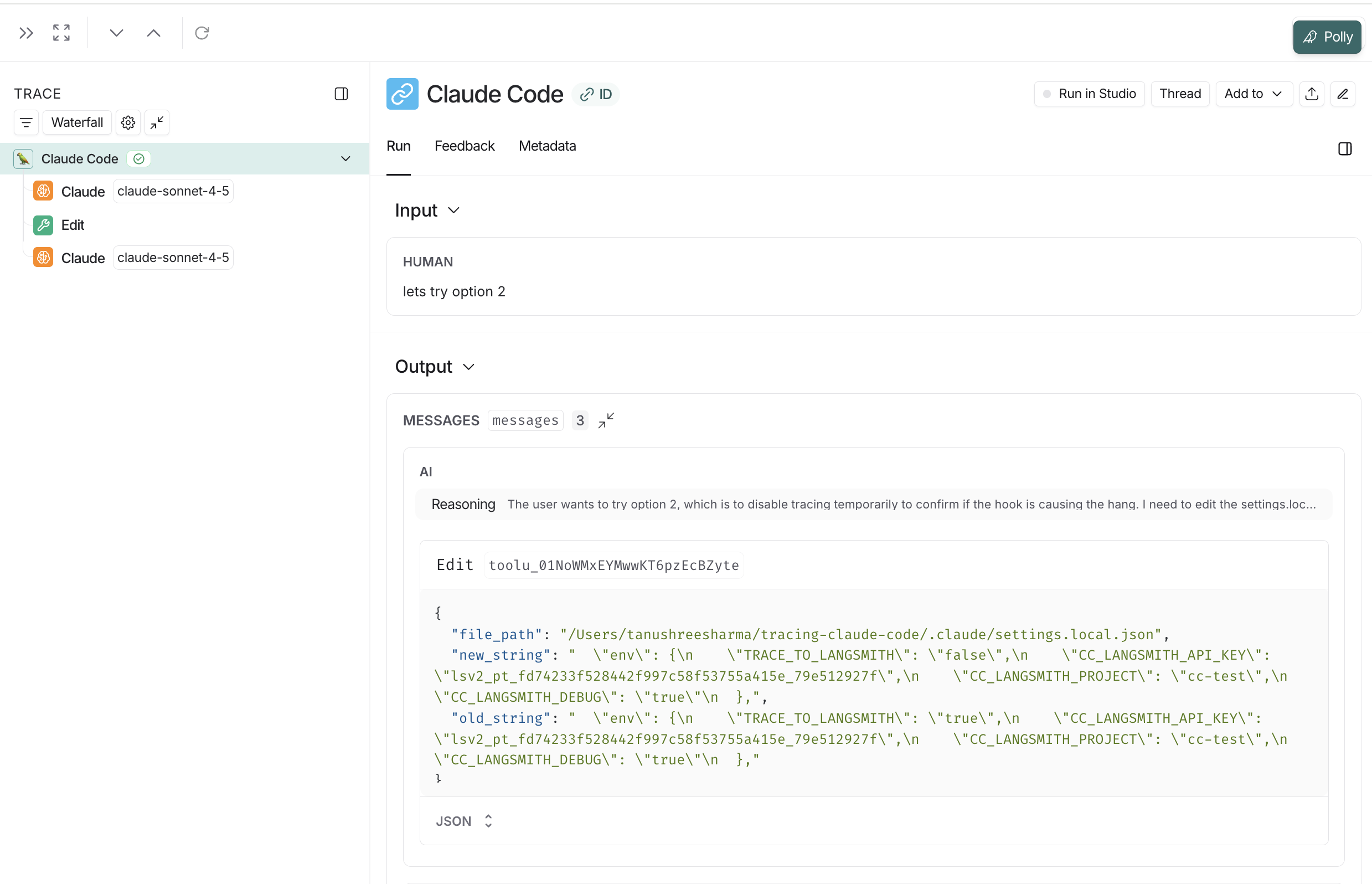
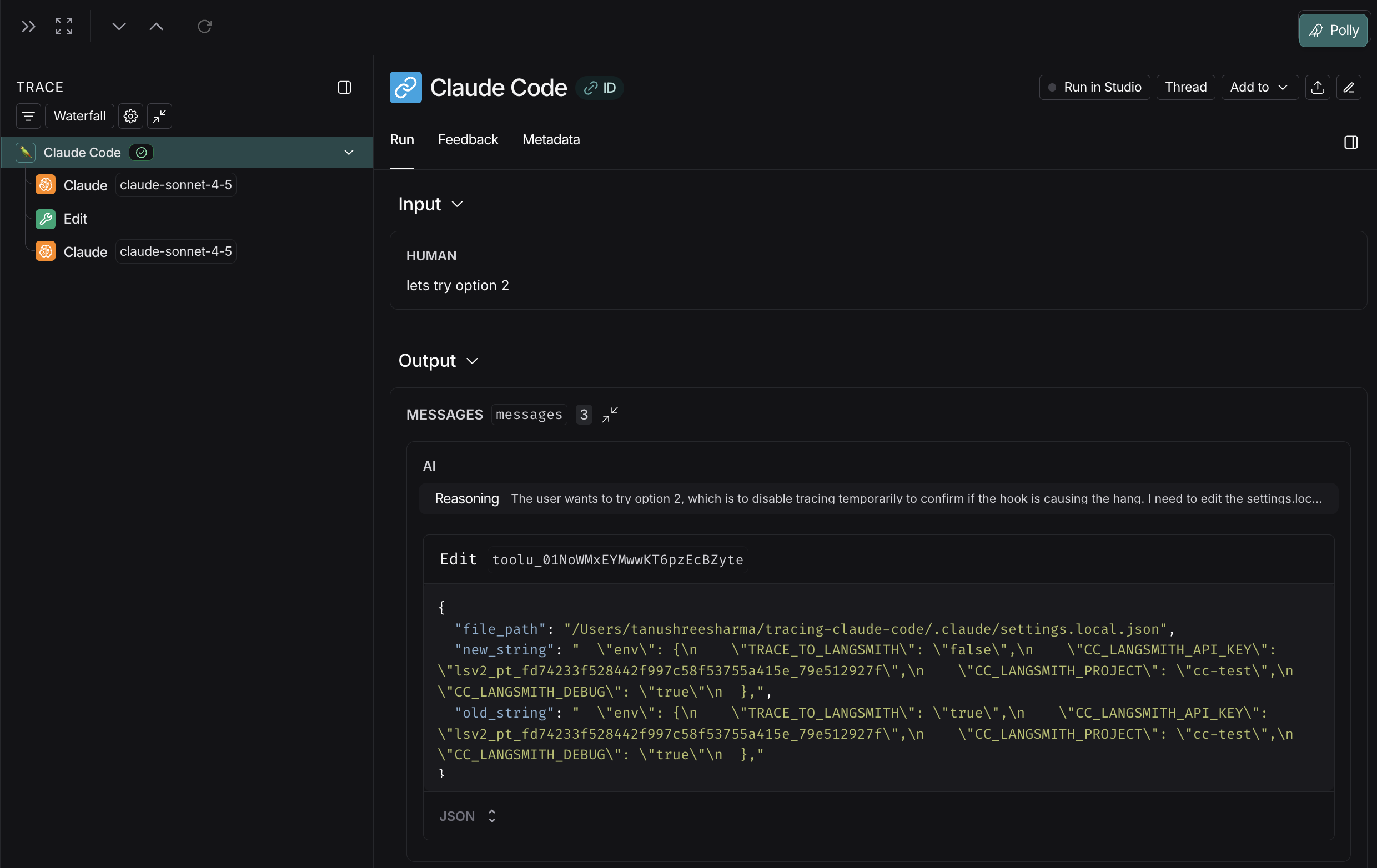
Start a Claude Code session in your configured project. Traces will appear in LangSmith after Claude Code responds.
In LangSmith, you'll see:
* Each message to Claude Code appears as a trace.
* All turns from the same Claude Code session are grouped using a shared `thread_id` and can be viewed in the **Threads** tab of a project.
## Troubleshooting
### No traces appearing in LangSmith
1. **Check the hook is running**:
```bash theme={null}
tail -f ~/.claude/state/hook.log
```
You should see log entries after each Claude response.
2. **Verify environment variables**:
* Check that `TRACE_TO_LANGSMITH="true"` in your project's `.claude/settings.local.json`
* Verify your API key is correct (starts with `lsv2_pt_`)
* Ensure the project name exists in LangSmith
3. **Enable debug mode** to see detailed API activity:
```json theme={null}
{
"env": {
"CC_LANGSMITH_DEBUG": "true"
}
}
```
Then check logs for API calls and HTTP status codes.
### Permission errors
Make sure the hook script is executable:
```bash theme={null}
chmod +x ~/.claude/hooks/stop_hook.sh
```
### Required commands not found
Verify all required commands are installed:
```bash theme={null}
which jq curl uuidgen
```
If `jq` is missing:
* **macOS**: `brew install jq`
* **Ubuntu/Debian**: `sudo apt-get install jq`
### Managing log file size
The hook logs all activity to `~/.claude/state/hook.log`. With debug mode enabled, this file can grow large:
```bash theme={null}
# View log file size
ls -lh ~/.claude/state/hook.log
# Clear logs if needed
> ~/.claude/state/hook.log
```
***
[Edit this page on GitHub](https://github.com/langchain-ai/docs/edit/main/src/langsmith/trace-claude-code.mdx) or [file an issue](https://github.com/langchain-ai/docs/issues/new/choose).
[Connect these docs](/use-these-docs) to Claude, VSCode, and more via MCP for real-time answers.